
Resources
Glossary
Caring for patients with a myriad of shoulder complaints, our philosophy is to educate patients about their conditions to allow them to take control of their ailments. We hope this section offers you insight. See Conditions or Common Surgical Procedures for more details.
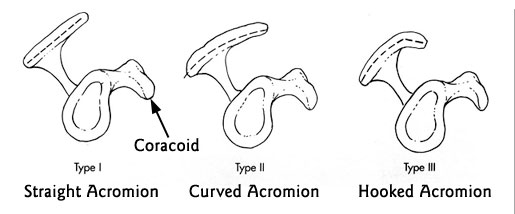
Part of the scapula, forms the roof above the supraspinatus tendon. Often has a hooked configuration that impinges on the supraspinatus tendon.
A condition whereby the ligaments connecting the top of the humerus and the glenoid become inflamed and thickened, leading to a painful tight shoulder.
Inflammation in a joint that often accompanies arthrosis.
Using a pencil-sized camera to visualize and treat problems within a joint.
The loss of articular cartilage so that the underlying bone is exposed.
The smooth covering of the ends of the bones in a joint. An everyday example is the articular cartilage found on the end of the knob of a chicken leg.
A muscle that runs up the front of the humerus and attaches the scapula to the forearm. It has two insertions on the scapula: the short head attaches to the coracoid process and the long head attaches to the top of the glenoid.
A slippery tissue designed to decrease the friction that resides between two moving surfaces. Often becomes inflamed and thickened.
A very painful condition related to degeneration of the rotator cuff tendon. The collagen fibers of the tendon change to a cartilage consistency (metaplasia) which then calcifies. The calcifications create inflammation which causes pain severe enough to make patients end up in the emergency room. The calcium deposits have no relation to dairy intake.
Click here to view video.
The collar bone. A cause of superior shoulder pain and the most commonly fractured shoulder bone.
Part of the scapula, insertion point for the short head of the biceps. Can cause impingememt syndrome on the subscapularis tendon.
A powerful muscle originating off the acromion and inserting on the humerus. It supplies the majority of the power in lifting the arm. A good functioning deltoid is necessary to perform a reverse shoulder replacement.
When the top of the humerus comes out of the socket.
Same as Adhesive Capsulitis.
Part of the scapula, forms the socket of the shoulder joint.
The upper arm bone that connects the shoulder blade to the elbow.
The rim of cartilage surrounding the glenoid on which the long head of the biceps tendon attaches as well as the ligaments connecting to the top of the humerus. Tears of the labrum can cause instability.
A surgical procedure where the coracoid process is transferred to the front of the glenoid to prevent the shoulder from dislocating.
A group of four muscles (subscapularis, supraspinatus, infraspinatus, and teres minor) that originate off the scapula. Their respective tendons form a cuff of tissue that inserts on the top of the humerus. They rotate the humerus but their primary role is to keep the top of the humerus centered on the glenoid.
The shoulder blade.
When the ligaments connecting the acromion and clavicle are injured.
A tear of the labrum involving the superior aspect of the labrum where the biceps tendon inserts.
Known as scapulothoracic bursitis, this conditions causes a painful crunching sensation in the upper back under the shoulder blade.
Anatomy
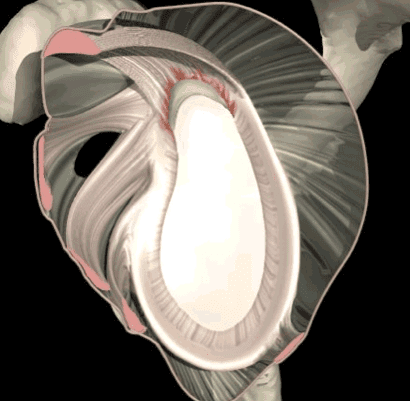
The shoulder joint is made up of a ball and socket. The top of the humerus is the ball. The ball is connected to the glenoid by flimsy ligaments. The ligaments offer the shoulder tremendous flexibility as well as stability to carry out every day activities.
Arthritis refers to a painful joint that is missing articular cartilage.
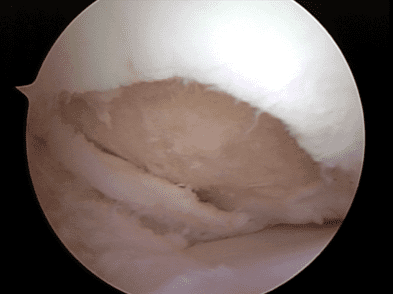
Articular cartilage is perhaps the most amazing structure around the joints. The surface of each bone is coated with articular cartilage at a joint. This material has no nerve fibers, a very low coefficient of friction, has no blood supply, and acts as a buffer for the underlying bone. Without nerves, there is no pain when two surfaces covered with articular cartilage rub against each other.
Articular cartilage is a very slippery surface with a coefficient of friction less than ice on ice. Coating the surface of our bones, articular cartilage enables our joints to move in a very efficient manner. Unfortunately, the lack of blood supply means that articular cartilage has a limited ability to heal itself. When the articular cartilage is damaged, the underlying bone may see excess pressure, and since the bone has many nerve fibers, this condition presents with pain. The complete loss of articular cartilage is the definition of arthrosis.
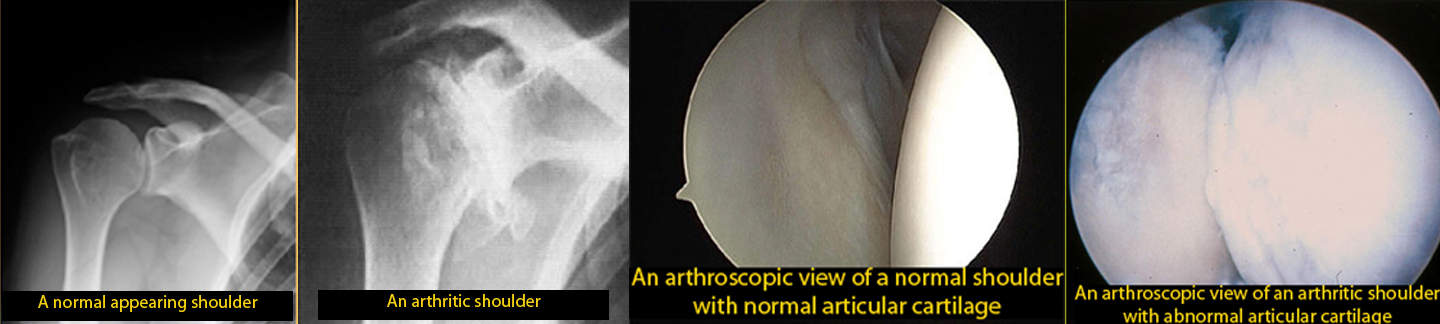
Inflammation in the setting of arthrosis is called arthritis.
The clavicle is the most commonly fractured bone in the shoulder. Clavicle fractures usually heal and rarely need surgery. It is uncommon to operate on a child with a clavicle fracture, as they invariably heal and remodel. In adults, clavicle fractures may be severe and can necessitate surgery if the bones are broken into several pieces or if the fracture ends are significantly displaced. 
The rotator cuff muscles originate on the scapula and are connected to the top of the humerus via the rotator cuff tendons. The tendons have poor blood supply and are prone to developing inflammation (rotator cuff tendonitis) as well as tears (rotator cuff tears)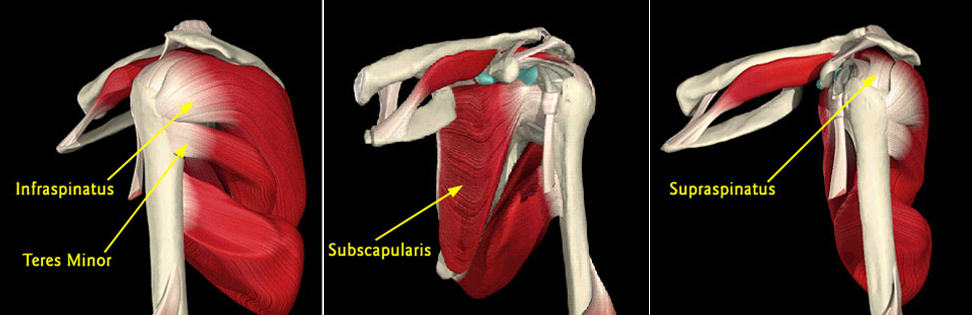 .
.
The shoulder is comprised of three bones and several muscles. The bones include the scapula (shoulder blade), the humerus (upper arm bone), and the clavicle (collar bone).
The scapula is a unique bone of the human body as it has many nooks and crevices and prominences. The top of the scapula is called the acromion and can be flat or curved. The acromion resides above the rotator cuff tendons and if the acromion is curved it can impinge or pinch on the rotator cuff when the arm is elevated. This is a common cause of shoulder pain known as impingement syndrome.
The coracoid process comes off the front of the scapula and also can cause irritation of the rotator cuff. Unlike impingement from the acromion, which causes pain down the side of the upper arm, coracoid impingement (also known as subcoracoid impingement) causes pain in the front of the shoulder. The glenoid or socket is the part of the scapula that articulates with the top of the humerus.
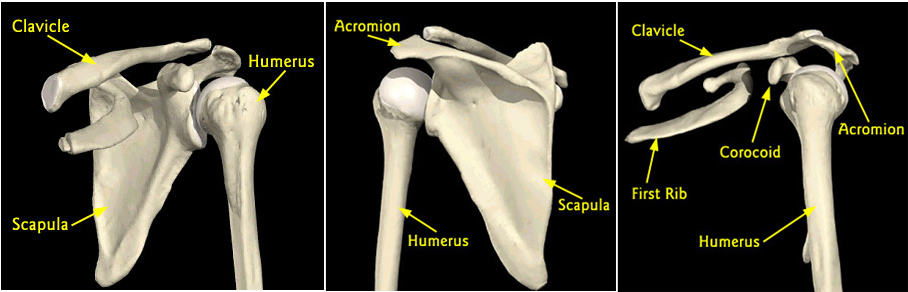
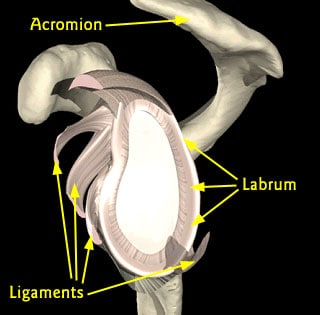 The shoulder joint is made up of a ball and socket. The top of the humerus is the ball. The ball is connected to the glenoid by flimsy ligaments that offer the shoulder tremendous flexibility, as well as stability to carry out every day activities.
When the ligaments are too loose, the shoulder may dislocate or slide too much. When the ligaments are too tight, the shoulder can be particularly painful, as is seen in adhesive capsulitis (frozen shoulder).